
5 migration trends in the Americas to watch in 2026
Reviewing how migration trends have changed in 2025 and highlighting what to watch in the new year

Se puede acceder aquí a una versión en español traducida por inteligencia artificial.
Consulte aqui uma versão em português do boletim traduzida por inteligência artificial.
Writing to you from Washington DC on what happens to be International Migrants Day, this year has had a lot going on, to say the least. Since starting the Americas Migration Brief in January 2023, I have written an annual special edition in December to review the year’s migration trends and outline key issues I’m watching in the new year. Check out the editions from 2023 and 2024.
Given time constraints during this busy second year of my PhD program, I am keeping this year’s version short. If you’d like to support this newsletter and my research and migration policy work more broadly, please consider becoming a paid subscriber to the AMB. A paid subscription also grants you access to the full archive of weekly briefs. If you are unable to commit to a recurring paid subscription at this time, I also accept one-time donations by PayPal here.
2025 has been a year of much change across the Americas. The Trump administration’s draconian policies have left the US-Mexico border quiet (thus far)1 and have terrorized local communities across the US. The repercussions of Trump’s policies across the hemisphere have been many, including a lack of funding and support for host countries across the region, new pressures to reintegrate returnees, and stalled progress on cooperation. Regional, collaborative, and constructive approaches to migration management have been thrown into disarray by the Trump administration’s personalistic, bilateral-focused negotiations and incessant flip-flopping.
While enforcement has grabbed headlines, quieter efforts to expand labor migration have grown. Debates over recruiting high-skilled migrants in countries such as Canada and the US have proliferated, while many in Latin America have looked for new pathways to outside of the hemisphere. Spain has continued to emerge as a leading destination for Spanish-speaking migrants in the region. And Ecuador, for its part, has inked new circular migration deals with countries such as Israel, Italy, and the UAE.
Large-scale movement across the region has slowed in 2025, but the push factors for once-historic migration levels in the 2020s have not gotten any better. Indeed, economic and security conditions have not improved in many countries, the acute crisis in Haiti persists, and the dictatorships in Cuba and Nicaragua remain resilient (more on Venezuela below). Challenges remain across the hemisphere, and few countries have displayed a willingness to accept new arrivals in the current moment. As a bright spot, though, Brazil has continued to grow as a welcoming destination for Cuban, Haitian, and Venezuelan migration.
With that, the following is a non-exhaustive list of key issues I’m paying close attention to in the new year:
Latin America’s Right wants to mimic Trump on migration
Venezuela’s future hangs in the balance
Canada could strengthen regional ties
The Caribbean’s free movement coalition could expand
Reintegration requires investment
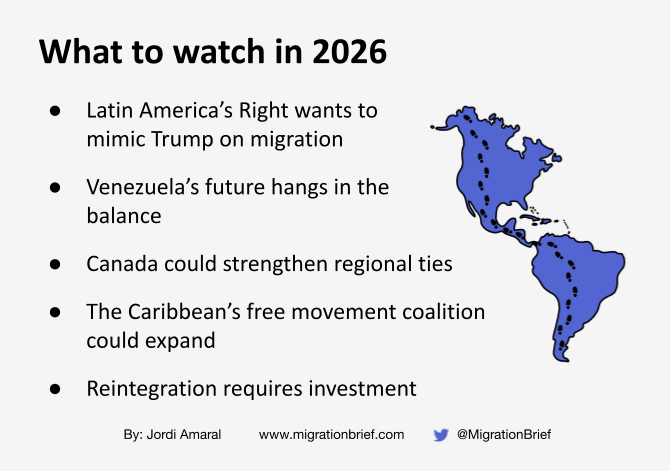
An anti-incumbent wave has brought new conservative governments to power across Latin America with promises of securitized, hardline immigration policy. Many of these leaders have invoked the policies of US president Donald Trump, planning to emulate the US Border Patrol model and pledging to deport irregular migrants who they frame as criminals. Last Sunday, far-right politician José Antonio Kast won the second round of Chile’s presidential elections, centering his campaign on immigration and security. How far are Kast and other leaders willing to go? Mass deportations are an expensive, logistically-complicated, and rights-averse endeavor, as the US and the Dominican Republic have shown. Furthermore, they are not necessarily as popular as some claim, as overreach with this has led to public pushback against Trump. Plus, with many countries currently lacking diplomatic relations with Venezuela, promises to deport the many Venezuelan migrants across the region, in particular, are hollow.
Kast, for his part, has already shifted his rhetoric towards promoting “self-deportation,” indicating recognition that a mass deportation campaign would be difficult in practice. In Argentina, meanwhile, Milei has flipped the script on the country’s once generally welcoming approach, attacking migrants rhetorically and rewriting laws to limit protections and facilitate expulsions. However, immigration is not an important political issue in Argentina, and it is unclear just how committed Milei may be to this apparent distraction from the cost-of-living challenges voters care more about. Amid rising insecurity, Ecuador’s Noboa and Peru’s interim president Jerí—the latter to be replaced in upcoming elections next year—have also adopted more securitized approaches. But the scope and future of these measures remain to be seen.
Venezuela’s Maduro regime is the most vulnerable it has been since 2019. For the roughly 8 million Venezuelans living abroad—the vast majority within Latin America and the Caribbean—the fall of the dictatorship would be reason for rejoicing and considering returning home. At the same time, chaotic efforts to dislodge the Maduro regime may well produce even more displacement from the country—something we have seen in years past. The country’s kleptocratic, repressive dictatorship is the root cause of ballooning displacement over the last decade, but to suggest that Maduro’s removal is a simple and easy solution misses the mark. A myriad of experts have written about this issue from a variety of perspectives; I have neither the time nor the space to litigate this debate here, but I will underscore that the unclear future of Venezuela is closely tied to the future of migration trends across the Americas.
Canada could strengthen ties to Latin America and the Caribbean. Full disclosure, I contributed to a recent report by the Canadian Council for the Americas outlining a new strategy for Canadian engagement with the region. Canada’s Carney government has an opportunity to expand relationships in the hemisphere and fill gaps left by the Trump administration, including on migration. Restarting the Safe Mobility Initiative and building strategic bilateral labor migration pathways would be mutually beneficial, while establishing a new mobility pact with Mexico could re-energize relations at a critical juncture. In the Caribbean, meanwhile, Canada could take leadership on humanitarian support for Haiti, establishing new partnerships with a regional leader in granting protection, Brazil.
Can the Caribbean full free movement coalition expand? CARICOM’s Barbados, Belize, Dominica, and St. Vincent and the Grenadines expanded from the bloc’s limited free movement regime to full free movement on October 1, 2025.2 Despite fears of mass migration and chaos by some, the initiative has quietly been a great success. Dozens of citizens have taken advantage of the new regime to cross borders, work, and set up lives with their families with ease. As fears of instability have been allayed, could other CARICOM nations join the fray? Jamaica, for example, was one of many countries previously considering the matter. With the September 2025 election in the rearview mirror, the Holness government could now be in a better position to conduct previously mentioned public consultations and join the initiative. Creating a free movement regime has been a boon for the Caribbean, and now time will tell if the coalition of beneficiaries can grow.
Finally, reintegrating those returning home requires investment. Reintegration has long been a relatively invisible quagmire, but skyrocketing deportations have highlighted the importance of such efforts. Will countries succeed and offer these returnees a reason to stay, or will frustrations build and eventually spark a new stage in hemispheric migration as many of those returned home set their sights abroad once again? IDB has a series of illuminating new studies looking at the returnee population and reintegration in Honduras, and MPI has examined some of the new policies adopted in Central America and Mexico to respond to the recent wave of deportations. More research and dedicated programming is certainly needed, but successful reintegration could in fact turn a challenge into a development opportunity for the region. In a similar vein, it remains to be seen how much Mexico can capitalize on stranded immigrants previously en route to the US to effectively integrate them and fill labor gaps. As has been the case for centuries, human mobility offers new opportunities to all those involved—conditional on good policy and adequate investment.
If you’ve made it this far, please consider joining me in my mission of viewing migration as a regional, interconnected phenomenon that requires we expand our attention to the whole of the hemisphere.
Nearly 4,000 subscribers read the AMB on a weekly basis, including:
Government officials from at least 16 countries in the Americas (and many more globally)
Policy thinkers and architects across 70+ think tanks and foundations
Practitioners from 20+ multilateral institutions
Advocates from 200+ civil society organizations
Academics from 200+ colleges and universities
Journalists and editors from 80+ media outlets
This community helps shape policy, inform action, and deepen understanding across the migration space. I hope you’ll consider becoming a paid subscriber at just $7/month or $65/year—or upgrading your current subscription to a founding membership at $150/year or more—to help sustain this work.
It remains an open question how long the current situation will continue. During the first Trump administration, border crossings initially plummeted before rebounding to new highs, eventually reaching record levels during the Biden administration. From another angle, the second Trump administration’s record lows follow significant drops in border crossings during the Biden administration’s final year.
More background on full free movement is available in a 2023 AMB special edition and AMB 9/22/25.